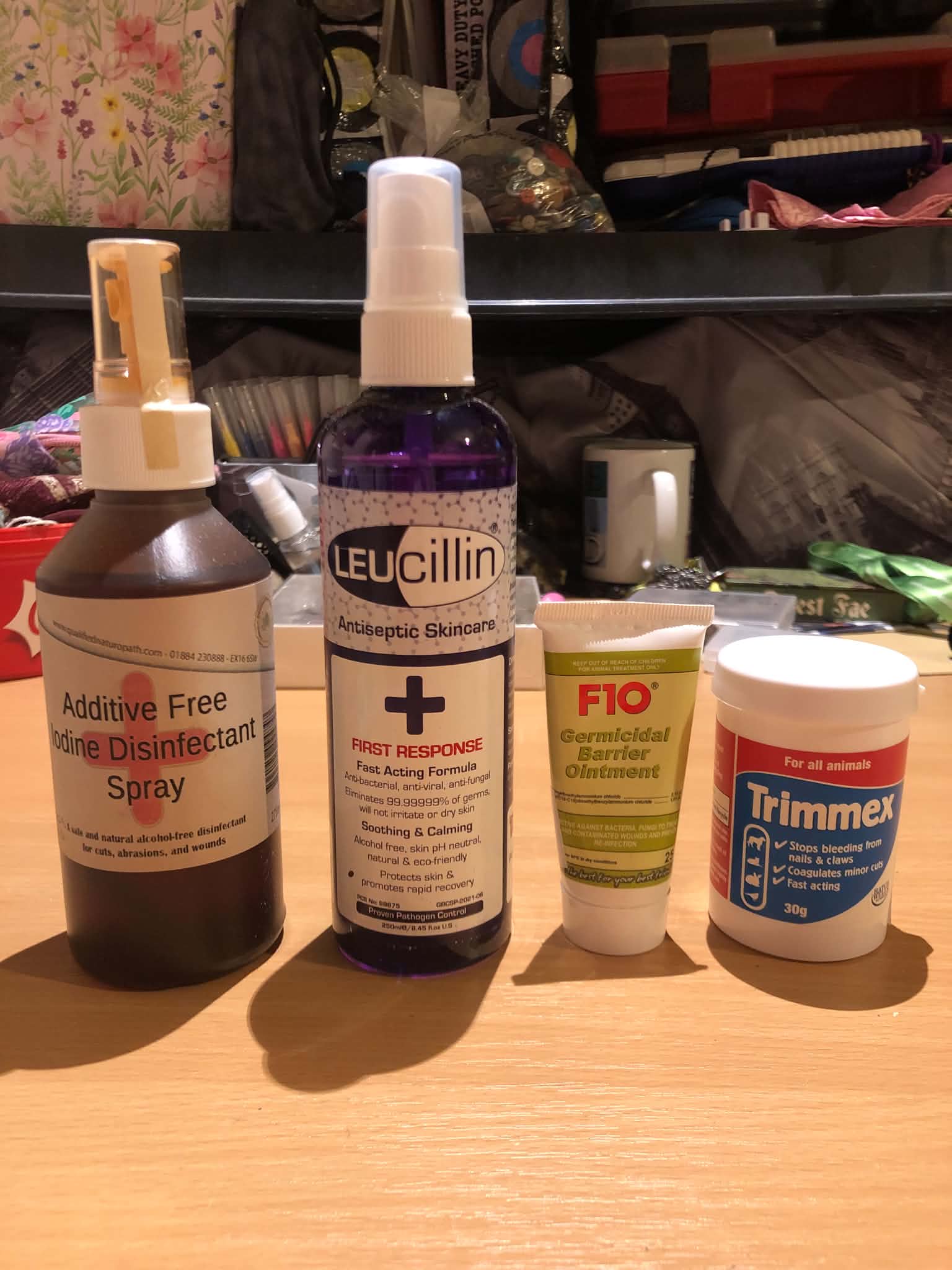
A pigeon stringfoot rescue kit
For helping the poor pigeons with strings tangled around their feet

Now let me preface this by saying By all possible means, attend a pigeon stringfoot rescue group or session in your area! Learning from people in-person will be a thousand times more valuable than reading a thing online. But, if that's not an option, well... having any knowledge is better than no knowledge. The first thing I took note of when attending the in person session (where the pics on the right are from) is what antiseptics and ointments they use. I *did* have a photo from on the field that I ordered mine off of, but it looks like the original pic has been deleted since then. I did however order the exact same brands and label designs as what the experts use, so what I have here is exactly what they have. Now, as I'm trying to make a travel kit, and don't really want to haul around 10 pounds of supplies with me, I got some 20ml spray bottles to put some of the Iodone and Leucillin in, and darkened the bottles to limit light exposure. I also got individually packaged alcohol free cleaning wipes to not have an entire household package go dry on me, and got a smaller container of Trimmex bleed stop. All of this will conveniently avoid contaminating the bulk containers, and the barrier ointment is applied with a cotton bud (so is the bleed stop, but that has a larger lid). Also, I have two pairs of tweezers only because I thought the thicker ones might be useful, though in our group, everyone generally preferred the pointy tipped tweezers. Thankfully during my session I was able to destring a pigeon myself as well as watch another one, so I could note exactly what they needed and used. It seems, at least with this group, the supplies needed are:
The process as I've experienced is thus: Spread birdseed around while hunched over, so the pigeons get used to your arms being close to the ground, and come around to eat. When you spot a pigeon with string around its feet, keep your eye on it, and slowly, patiently wait for it to get close to you, with its back to you. It may take 10 minutes, it may not happen, but this is the goal. Quickly, gently and without hesitation reach your hand forward and grasp the back of the pigeon around the wings, kinda securing it against the ground. May not happen the first attempt, might fly away and not come back anytime soon, but again this is the goal. Once you've secured them to the ground (all the others will have likely fluttered away, it's a bit of a chaotic moment), wrap your towel over them in general, pick them up from below with your other hand so they're grasped in both, and cuddle their head against your chest to calm them. Also if your towel is out of reach, just cuddle their head to you and walk them to your towel and supplies, where you then wrap them in general in the towel, keeping the feet free. Flip them upside down so you have access to the feet on your lap, and arrange their legs between your non-dominant index and middle fingers to gain good access to the feet. Spray the string with the Leucillin to disinfect the area and soften the string, and wait a few moments. At any point if getting to the string is difficult, spray more Leucillin. The cotton buds can be used to wipe out the groove that the string has created for better visibility. Using alternately the scissors or the tweezers, grasp, cut, and unwind the string. If you don't know which way it's wound around (likely), I've been told to just kinda pull it towards the tip of the toe in general so it'll unwind either way. Do what you can. Note: You might not be successful, it's possible, don't feel horrible, you've done your best. In either case, with the scissors and tweezers you can generally feel the string in there, do what you can to cut and remove it. Wiping the tip of the scissors and tweezers on the towel helps in cleaning the tip. Once you're done, if it's bleeding, collect some Trimmex on a cotton bud and spread it into the wound. After this apply some F10 Barrier Ointment to fight off any bacteria, and give it a few moments to soak into there. Finish by spraying Iodine Disinfectant over the wound, and flip the pigeon over in your lap so they're rightside up again, and uncover their head. Offer some birdseed/bird peanuts in your hand right in front of them like the pic to the right, and they may or may not take it, but it's a nice offer. After a few moments of letting them see where they are and such, let them free, and they'll flutter off, and you've done what you can ❤️ Note: From my limited experience, the pigeons have always been calm and immobile through all of this, you can feel their warmth and their breathing on your legs, and generally they don't move at all while their head is covered. Spotting a stringfoot pigeon can be easy, the toe is usually very swollen, or the string is just plain visible, and it may be limping. Keep your eye on it while spreading the birdseed around. ------- I collected all the supplies and figured out what size of container I would need to fit everything, and ordered a Pelican case to do exactly that. With that and a large pouch of birdseed, our pigeon stringfoot rescue kit is complete and ready for use! Group session attended October 15, 2026 Kit finished October 30, 2026  |